Blog
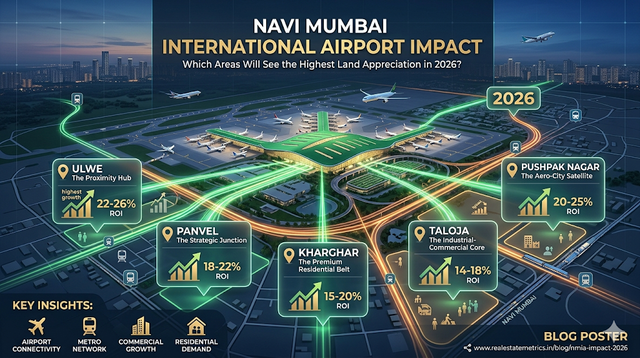
Navi Mumbai International Airport Impact: Which Areas Will See the Highest Land Appreciation in 2026?
The Navi Mumbai International Airport is reshaping real estate across MMR. From Ulwe to Dronagiri, discover the top investment zones before property prices surge in 2026.
6 June 2026Plotzify
Introduction: The Airport That Is Rewriting Maharashtra's Real Estate Map
There are rare moments in the history of any city when a single infrastructure project changes everything — the way land is valued, the way communities grow, and the way investors build generational wealth. The Navi Mumbai International Airport (NMIA) is that once-in-a-generation catalyst for the Mumbai Metropolitan Region (MMR).
Situated near Ulwe in the Raigad district, the NMIA is India's most anticipated airport project of the decade. Spanning 1,160 hectares and designed to handle over 60 million passengers annually at full capacity, it represents not just a transportation upgrade but a massive economic redistribution event. Land prices, infrastructure investments, commercial activity, and residential demand are all being recalibrated in response to its imminent opening.
For investors, the question is no longer whether to invest near NMIA — it is where exactly to invest, at what price point, and with what time horizon. In this comprehensive guide, we break down every significant micro-market in the NMIA catchment zone, explain the infrastructure drivers, decode the price trends, and help you understand precisely which areas will see the highest land appreciation in 2026 and beyond.
At Plotzify, we have been tracking land investment trends across Maharashtra for years. Our data-driven insights help investors identify pre-surge opportunities before mainstream media catches on. Let us take you through everything you need to know.
Why Airports Are the Ultimate Real Estate Catalysts
Before diving into specific zones, it is important to understand the fundamental economic logic of why airports drive land appreciation. When an international airport becomes operational in a region, it triggers a multi-decade cycle of growth that unfolds across several phases:
Phase 1: Announcement and Planning (Land Accumulation Phase)
When an airport is announced, informed investors and institutional players begin accumulating land in a 30–50 km radius. This phase — which NMIA has been in since the early 2010s — typically sees early-mover returns of 2x–4x for those who act before public awareness peaks.
Phase 2: Construction and Infrastructure Build-Up
Roads, metro lines, utility corridors, and commercial zones develop around the airport in anticipation of operations. This is the phase NMIA's surrounding areas are in right now. Land prices begin rising steeply as construction timelines firm up and government projects accelerate. This is still a good entry window for medium-term investors.
Phase 3: Operational Phase — Exponential Commercial Growth
Once the airport opens, it creates thousands of jobs, drives hotel, retail, and logistics development, and attracts corporate headquarters. Land prices within 20 km typically see their most dramatic jumps — often 40–80% within the first 3 years of operation.
Phase 4: Saturation and Secondary Growth
The primary zone saturates in terms of affordability. Demand spills into secondary zones (20–50 km), driving the next wave of appreciation. Areas like Khalapur, Pen, and Alibag are set to benefit from this mechanism.
India's own history validates this pattern. Land near Bengaluru's Kempegowda Airport (BIAL) — which was once accessible farmland — now commands ₹15,000–₹25,000 per sq. ft. Hyderabad's RGIA has driven the entire Shamshabad–Shadnagar corridor from ₹400 per sq. ft. to ₹6,000+ in fifteen years. NMIA is on a similar — if not stronger — trajectory given Mumbai's inherent demand gravity.
The Navi Mumbai International Airport: A Complete Overview
Project Specifications
Parameter Details
Location Ulwe, Panvel, Raigad District
Total Area 1,160 hectares
Developer CIDCO (City and Industrial Development Corporation)
Phase 1 Capacity 10 million passengers/year
Full Capacity 60 million passengers/year
Runways (Phase 1) 2 (expandable to 4)
Estimated Cost ₹16,704 crore (Phase 1)
Expected Opening 2025–2026
Operator Adani Airport Holdings Limited
Why NMIA Is Different from Other Airport Projects
NMIA is being developed in one of the most densely populated and economically active metro regions in the world. Unlike greenfield airports in smaller cities, this airport benefits from:
• A ready catchment of 25+ million people across MMR
• Existing road, rail, and sea connectivity backbone
• CIDCO's planned satellite townships providing built-in residential demand
• Proximity to JNPT — India's busiest container port — enabling air-sea cargo synergies
• The Mumbai Trans Harbour Link (MTHL / Atal Setu) providing direct South Mumbai access
• Multiple metro lines under construction connecting the airport to MMR nodes
The Infrastructure Web Supercharging NMIA's Impact
No airport operates in isolation. NMIA is at the center of Maharashtra's most ambitious infrastructure deployment in history. Understanding these projects is key to understanding land appreciation zones:
1. Mumbai Trans Harbour Link (MTHL / Atal Setu)
The 21.8 km Atal Setu — India's longest sea bridge — connects Sewri in South Mumbai to Nhava Sheva in Uran. It has reduced travel time from South Mumbai to Navi Mumbai from 90 minutes to just 20 minutes. For NMIA, this means that Mumbai's 6 million daily commuters can now reach the airport in under 30 minutes, dramatically expanding its catchment and real estate influence.
Land Impact: Properties along the Nhava Sheva–Ulwe–Panvel corridor have already seen 30–50% appreciation since MTHL's inauguration in January 2024. Expect further compounding as NMIA opens.
2. Navi Mumbai Metro Rail Network
CIDCO is developing a multi-line metro network across Navi Mumbai:
• Line 1 (Belapur–Pendhar): 11.1 km, connecting Ulwe to Belapur CBD
• Line 2 (Pendhar–Kharghar–Belapur): 13.1 km circular route
• Line 3 (Airport–CBD Belapur): Direct airport metro connectivity
Metro accessibility multiplies property values. Research across Indian cities shows that properties within 500 metres of metro stations appreciate 15–25% more than comparable properties in non-metro zones.
3. Virar–Alibaug Multimodal Corridor (VAMC)
This 126 km corridor will connect Virar in the north to Alibaug in the south, passing through key nodes including Panvel, Khalapur, and Pen. With eight lanes, dedicated freight lanes, and connections to four national highways, the VAMC will be the spine of a new economic mega-corridor. Land along and adjacent to its path is already attracting institutional interest.
4. Panvel–Karjat Rail Corridor
This new rail link will dramatically improve east-west connectivity through the Raigad district, connecting Panvel's airport-adjacent zone to the heritage hills of Karjat. It opens up Khalapur and intermediate stations to commuter demand from NMIA-dependent workers.
5. JNPT Expansion (Phase 4)
Jawaharlal Nehru Port Trust is expanding capacity from 9.4 million TEUs to 18 million TEUs by 2030. Combined with NMIA's air cargo terminal, the Panvel–Uran–JNPT triangle will become India's most powerful logistics hub — generating enormous industrial land demand.
6. NH-48 and NH-66 Widening
The widening of NH-48 (Mumbai–Pune Expressway feeder road) and NH-66 (Coastal Highway) is significantly improving road access to NMIA from both the north and south. New interchanges and service roads are unlocking previously inaccessible land parcels.
Top 10 Areas Near NMIA for Highest Land Appreciation in 2026
1. Ulwe — The Airport's Ground Zero
Ulwe is ground zero for NMIA-driven appreciation. It sits immediately adjacent to the airport site and is being developed by CIDCO as a planned residential township. With sector-based development, tree-lined roads, underground utilities, and a mix of affordable and premium housing, Ulwe is transforming from a semi-rural settlement into Navi Mumbai's next major urban hub.
Current Market Conditions:
• Residential plot rates: ₹9,000–₹16,000 per sq. ft.
• CIDCO plot allotment lottery schemes regularly oversubscribed 10:1
• Commercial land near sector access roads: ₹14,000–₹22,000 per sq. ft.
• Year-on-year appreciation: 22–35%
Why Ulwe Will Continue to Appreciate:
• Metro connectivity (Line 3 direct airport link) under construction
• CIDCO developing schools, hospitals, and retail zones within planned sectors
• High NRI interest — Ulwe is becoming the preferred address for Mumbai NRIs returning home
• Limited land availability as CIDCO phases out direct allotments
Investment Projection: Experts forecast 45–60% cumulative appreciation from current levels over the next 3 years. Early entry in Sectors 17–22 still offers value.
💡 Expert Pick: Ulwe Sector 19 and Sector 22 offer the best balance of affordability and appreciation potential within the immediate airport zone.
2. Panvel — Airport Gateway and Investment Magnet
Panvel has been on investors' radar for over a decade, but the NMIA has given it a second and more powerful wind. As the primary urban centre closest to the airport (10–15 minutes drive), Panvel is transforming from a Tier-2 node into a full-fledged metropolitan hub. CIDCO's Greater Panvel development plan envisions it as a city of 2 million residents by 2031.
Investment Hotspots within Panvel:
• Old Panvel (Near Railway Station): Commercial and mixed-use land. Price: ₹8,000–₹13,000/sq. ft.
• New Panvel: Residential plots with good infrastructure. Price: ₹7,000–₹12,000/sq. ft.
• Karanjade: Emerging residential corridor. Price: ₹5,500–₹9,000/sq. ft.
• Kalamboli: Industrial and commercial zone. Price: ₹6,000–₹10,000/sq. ft.
Infrastructure Accelerators for Panvel:
• MTHL connector road directly links Panvel to South Mumbai
• Panvel Railway Station redevelopment (world-class multimodal hub planned)
• Panvel–Karjat Rail (new line under construction)
• Metro Line extensions bringing Panvel into the Navi Mumbai Metro grid
Long-term, Panvel's proximity to both the airport and JNPT makes it ideal for commercial, hospitality, and executive residential investment. Expect 35–50% appreciation over the next 3 years in the right micro-zones.
3. Dronagiri — The SEZ and Port-Linked Powerhouse
Dronagiri is arguably the most strategically positioned node in the NMIA catchment zone. Located between JNPT and NMIA, it has been designated for a massive SEZ (Special Economic Zone) and port-linked industrial development by CIDCO. If you understand the long-term game of how industrial cities are built, Dronagiri is your highest-conviction buy.
Key Development Plans:
• Dronagiri SEZ: 1,600 hectares earmarked for industrial, logistics, and commercial development
• Port connectivity via JNPT road and proposed coastal road
• CIDCO's integrated township plan for residential and commercial development
• Proposed metro extension to Dronagiri from Belapur/Ulwe
Land Pricing and Appreciation Potential:
Land Type Current Price 3-Year Projection
Industrial Plot ₹5,000–₹9,000/sq.ft. ₹9,000–₹16,000/sq.ft.
Residential Plot ₹7,000–₹12,000/sq.ft. ₹12,000–₹20,000/sq.ft.
Commercial Land ₹12,000–₹18,000/sq.ft. ₹20,000–₹32,000/sq.ft.
💡 Institutional Signal: Multiple Fortune 500 logistics and manufacturing companies have quietly acquired land in Dronagiri over the last 3 years. Smart money is already in.
4. Uran — The Coastal Residential and Commercial Frontier
Uran occupies a unique position: it is both a coastal residential destination and an industrial/logistics hub owing to JNPT proximity. The MTHL has collapsed the distance between Uran and South Mumbai from 90 minutes to 20 minutes — a transformation equivalent to what the Western Express Highway did for Andheri decades ago.
Current investment landscape:
• Coastal residential plots: ₹5,500–₹10,000/sq. ft.
• Industrial land near JNPT: ₹6,000–₹11,000/sq. ft.
• Appreciation in last 3 years: 70–100%
• NRI demand: Rapidly rising — coastal homes with Mumbai access are a rare combination
Uran still has meaningful upside given that the MTHL's full traffic impact is yet to be realized and NMIA will add air connectivity to the equation, making Uran a two-pronged beneficiary of sea and air infrastructure.
5. Pen (Raigad) — The Logistics Goldmine
Pen is undergoing a quiet transformation from a small market town into a logistics and industrial hub. Its location — equidistant between JNPT, NMIA, and Raigad district headquarters — makes it attractive for warehousing, cold storage, and light manufacturing. Government land acquisition for the Virar–Alibaug Corridor has also spiked interest in Pen's surrounding villages.
• Average NA plot price: ₹1,800–₹4,500/sq. ft.
• Agricultural land: ₹400–₹1,200/sq. ft.
• Projected appreciation (5 years): 60–90%
• Emerging demand driver: Air cargo logistics operators scouting for warehousing near NMIA
6. Khalapur — The Expressway-Anchored Wild Card
Khalapur sits at the intersection of the Mumbai–Pune Expressway and the secondary airport influence zone (35–40 km from NMIA). It is simultaneously benefiting from airport-driven demand and the Mumbai–Pune corridor's perpetual industrial momentum. Agricultural and NA land here is still available at ₹800–₹2,500 per sq. ft. — one of the last affordable entry points in the broader NMIA zone.
For more details on Khalapur, see our dedicated deep-dive blog.
7. Rasayani — The Chemical and Pharma Industrial Zone
Rasayani MIDC is one of Maharashtra's oldest and most productive industrial zones, specialising in chemicals, petrochemicals, and pharmaceuticals. As NMIA improves air connectivity for raw material imports and finished goods exports, industrial land near Rasayani becomes more strategically valuable. Current industrial plot prices: ₹2,500–₹5,500 per sq. ft. with steady demand from expansion-stage companies.
8. Taloja — The MIDC Expansion Hub
Taloja MIDC's Phase 2 and Phase 3 expansions are attracting automotive, pharmaceutical, and consumer goods manufacturers. The airport improves international business connectivity for companies based here. Residential demand from MIDC employees is driving plotted development projects in Taloja's periphery. Land prices: ₹3,500–₹7,000 per sq. ft.
9. Karanjade and Kalamboli — Affordable Residential Options
These Panvel-adjacent micro-markets offer affordable residential plots for middle-income buyers who cannot afford Ulwe's premium pricing. With improving road connectivity and the Panvel metro node, they offer solid appreciation potential of 25–40% over 3 years at entry prices of ₹4,500–₹8,000 per sq. ft.
10. Belapur CBD — Commercial Land for Premium Investors
Belapur CBD is Navi Mumbai's established central business district. As NMIA operations boost corporate activity in the region, Belapur's commercial land demand will increase from businesses wanting proximity to the airport without paying Ulwe's premium. Commercial plot prices: ₹18,000–₹35,000 per sq. ft. with strong rental income potential.
Investment Strategy: How to Maximize Returns from NMIA's Impact
Strategy 1: The Early Mover — Buy Affordable in Secondary Zones
If you missed the primary zone (Ulwe, Dronagiri), focus on secondary zones (Pen, Khalapur, Rasayani) where entry prices are still affordable and the appreciation trajectory mirrors the primary zones with a 2–3 year lag. A ₹50–₹75 lakh investment in Khalapur today could realistically be worth ₹1.5–₹2.5 crore in 7 years.
Strategy 2: The Infrastructure Bet — Buy Along Corridor Projects
Identify land parcels adjacent to the VAMC route, metro station proposals, or new road interchanges. Corridor-adjacent land has historically delivered 2–4x higher appreciation than general area averages. Use government notifications and MSRDC maps to identify proposed alignments.
Strategy 3: The Commercial Play — Hotel and Hospitality Land
Airport-adjacent commercial land for hotels, serviced apartments, and F&B establishments is in acute short supply. With 10 million passengers expected in Phase 1 alone, hospitality demand will be enormous. Commercial land within 5 km of the airport is already being acquired by major hotel chains.
Strategy 4: The Industrial Anchor — Logistics and Warehousing
Air cargo will be a key revenue driver for NMIA. Perishables, pharmaceuticals, electronics, and luxury goods require temperature-controlled warehousing near the airport. Industrial plots in Pen, Taloja, and Rasayani positioned for this use case will deliver both appreciation and rental yield.
Strategy 5: The Residential Bet — CIDCO Plotted Schemes
CIDCO periodically releases plotted residential schemes in Ulwe, Kharghar, and Pushpak Nagar. These lottery-based allotments are consistently oversubscribed and resell at 30–50% premium within 2 years. Register with CIDCO and participate in upcoming schemes for near-guaranteed returns.
Due Diligence Checklist Before Buying Near NMIA
1. Verify NA conversion certificate or CIDCO/RERA project registration
2. Check 7/12 extract and mutation records for agricultural land
3. Confirm land is not in CRZ (Coastal Regulation Zone) — critical for Uran and coastal areas
4. Check for any encumbrances, mortgages, or government acquisition notices
5. Verify building plan approvals and layout sanctions from the relevant authority
6. Confirm connectivity to municipal water, sewage, and electricity grid
7. Get a local advocate to conduct a thorough title search going back 30 years
8. Check for any pending litigation or disputes in revenue records
For access to pre-vetted, legally clear land listings near NMIA, visit Plotzify.com — all listings undergo verification before being published on our platform.
Market Outlook: NMIA Land Appreciation Forecast for 2025–2028
Zone Current Price Range 2026 Projection 2028 Projection Key Driver
Ulwe ₹9,000–₹16,000/sq.ft. ₹13,000–₹24,000 ₹18,000–₹35,000 Airport opening, Metro
Panvel ₹7,000–₹13,000/sq.ft. ₹10,000–₹20,000 ₹14,000–₹28,000 MTHL, Airport gateway
Dronagiri ₹7,000–₹12,000/sq.ft. ₹12,000–₹20,000 ₹18,000–₹30,000 SEZ, JNPT, Metro
Uran ₹5,500–₹10,000/sq.ft. ₹8,000–₹15,000 ₹12,000–₹22,000 MTHL, Coastal living
Pen ₹1,800–₹4,500/sq.ft. ₹3,000–₹7,000 ₹5,000–₹11,000 Logistics, VAMC
Khalapur ₹800–₹2,500/sq.ft. ₹1,500–₹4,000 ₹2,500–₹6,500 Expressway, Secondary zone
⚠️ Important Disclaimer: Price projections are based on historical trends and current infrastructure data. Real estate markets are subject to policy, economic, and geopolitical variables. Always consult a financial advisor before investing.
Ready to identify the right plot at the right price? Explore NMIA-zone listings on Plotzify.com.
Frequently Asked Questions (FAQs)
Q1. When will the Navi Mumbai International Airport officially open?
As of the latest available information, Phase 1 of NMIA is targeted for 2025–2026. The airport's operator, Adani Airport Holdings, has confirmed that civil work is substantially complete and equipment installation is underway. However, airport projects of this scale are subject to regulatory, environmental, and operational clearances, so investors should track CIDCO and Ministry of Civil Aviation announcements for precise dates. Regardless of the exact opening date, the land appreciation around NMIA has already begun and will continue for years post-opening.
Q2. Which is the most affordable area near NMIA with high appreciation potential?
For investors seeking affordability combined with upside, Pen and Khalapur offer the best value. Agricultural and NA plots in Pen are available between ₹1,800–₹4,500 per sq. ft., while Khalapur offers entry points as low as ₹800 per sq. ft. for NA plots. Both areas are in the NMIA's 40–50 km influence radius and will see appreciation as the airport becomes operational and the Virar–Alibaug Corridor develops. Investors with a 5–7 year horizon should strongly consider these zones.
Q3. Can NRIs purchase land near Navi Mumbai International Airport?
Yes, NRIs (Non-Resident Indians) can freely purchase residential and commercial land in India, including in the NMIA zone. They can purchase NA-converted (Non-Agricultural) residential plots, commercial plots, and developed layouts without restriction. However, NRIs are generally prohibited from purchasing agricultural land unless it is inherited. For CIDCO-developed plots, NRIs can apply directly through CIDCO's official lottery schemes. Plotzify recommends NRIs work with a registered real estate agent and a local property lawyer to navigate the documentation requirements.
Q4. What documents should I check before buying land near NMIA?
Essential documents include: (1) 7/12 extract (Satbara Utara) — confirms ownership and agricultural/non-agricultural status; (2) NA Order — confirms Non-Agricultural conversion; (3) Property Card (City Survey Department); (4) Search Report from a licensed advocate — confirms clear title for past 30 years; (5) Encumbrance Certificate — confirms no mortgage or lien; (6) RERA registration (for plotted developments); (7) Layout plan approved by the relevant authority (CIDCO, Gram Panchayat, or municipal body); (8) No Objection Certificates (NOCs) from CIDCO, NHAI, and CRZ authority if applicable. Skipping any of these steps can expose buyers to significant legal and financial risk.
Q5. How does the Mumbai Trans Harbour Link (MTHL) affect land prices near NMIA?
The MTHL (Atal Setu) has been transformational. By reducing South Mumbai–Navi Mumbai travel time from 90 to 20 minutes, it has effectively made Ulwe, Panvel, Uran, and Dronagiri commutable from South Mumbai — something previously unimaginable. Land prices in the MTHL corridor appreciated 30–50% in the 18 months surrounding its inauguration in January 2024. Going forward, as NMIA opens and metro connectivity improves, the MTHL acts as a force multiplier — allowing the airport's economic benefits to reach not just Navi Mumbai residents but the entire South Mumbai business community.
Q6. Is it safe to invest in agricultural land near NMIA for long-term returns?
Investing in agricultural land near NMIA can yield exceptional returns but carries higher risks than NA plots. The key risk is the uncertainty of and timeline for NA conversion. Areas within active development zones (CIDCO jurisdictions, industrial belts) have faster conversion pathways and lower risk. Areas in environmental buffer zones or CRZ may face permanent development restrictions. We recommend purchasing agricultural land only with a 7–10 year horizon, after thorough legal due diligence, and ideally in zones where CIDCO or government has published development plan amendments showing future residential or industrial use. Plotzify's advisory team can help identify compliant opportunities.
Q7. What is the best investment ticket size for NMIA zone land?
Entry strategies vary by budget: Under ₹30 lakh — focus on agricultural land in Khalapur or Pen with conversion potential; ₹30–₹75 lakh — NA residential plots in Pen or Karanjade; ₹75 lakh–₹1.5 crore — residential or commercial plots in Panvel, Taloja, or Uran; ₹1.5 crore+ — premium residential or commercial plots in Ulwe or Dronagiri. Regardless of ticket size, the principles of clear title, RERA compliance, and infrastructure adjacency apply universally.
Q8. How does NMIA compare to other Indian airport real estate plays?
NMIA is arguably the most powerful airport real estate opportunity in India today for several reasons: (1) It serves the MMR — India's largest urban economy; (2) It has multiple reinforcing infrastructure triggers (MTHL, Metro, VAMC); (3) Its surrounding zone already has established MIDC industrial demand providing a floor for appreciation; (4) CIDCO's planned townships create built-in residential demand; (5) Air traffic growth in India is projected to compound at 8–10% annually through 2035. By comparison, Bengaluru and Hyderabad airports served less mature, smaller metro regions at the time of their openings. NMIA's macro context is stronger.
Q9. Will NMIA affect property prices in existing areas of Navi Mumbai like Kharghar, Nerul, or Belapur?
Yes, though the impact will be indirect and secondary rather than primary. Established nodes like Kharghar, Nerul, and Belapur will see corporate and residential demand increase as more businesses and professionals relocate to take advantage of airport connectivity. Commercial land in Belapur CBD will particularly benefit from increased corporate occupancy. However, the primary appreciation story remains in the inner ring (Ulwe, Dronagiri, Uran) and outer ring (Pen, Khalapur, Rasayani) of the airport's direct influence zone.
Q10. Where can I find verified land listings near Navi Mumbai International Airport?
Plotzify.com is India's dedicated land investment platform offering verified listings across the NMIA catchment zone. Every property on Plotzify undergoes legal and documentation verification before listing. You can filter by location, price range, land type (NA/Agricultural/Commercial), and connectivity parameters. Our team of real estate experts provides free consultation to help you identify the right plot based on your budget, horizon, and risk profile.
Navi Mumbai International AirportNMIA real estateland appreciation 2026Ulwe land pricesPanvel property investmentNavi Mumbai land investmentCIDCO plotsreal estate near airport MumbaiMMR land appreciationKhalapur investmentPen real estateDronagiri landMTHL impact propertyMumbai real estate 2026best areas to buy land near Mumbaiplot near Navi Mumbai airportairport real estate Indiaproperty appreciation Mumbai suburbbuy land near NMIAPlotzify land investmentMumbai Metropolitan Region real estatereal estate hotspot Maharashtraresidential plots near airportJNPT land pricesRaigad district investmentpre-surge land dealsNA plots near NMIACIDCO approved landairport proximity land returnsinfrastructure-led appreciation Mumbai
